Getting Used to Being Watched
My job has always been a little bit of everything. Email marketing, content writing, getting that content in front of people, search engine optimisation, a bit of social media. If it involves words and someone needing to read them, it’s probably landed on my desk at some point.
The part I’ve always loved most, though, is the storytelling. Finding the angle. Taking something complicated and breaking it down into a shape people can actually understand, and I mean people who don’t already know the topic inside out. That bit never got old.
So when AI came along and started doing some of that work, I didn’t exactly welcome it with open arms.
AI Arrived and I Was Slow on the Uptake
I’d love to tell you I took to it straight away, but I really didn’t. It was overwhelming. It was new, I had to learn it from scratch, and it was moving so fast that every time I thought I’d caught up, it had moved again. I was slow on the uptake, and when I did use it, I wasn’t happy with what came out. It felt like it was working against me.
Some days, if I’m honest, it still does. There’s always something new to learn, something new to adopt, something new to adapt to. I don’t think there’s a finish line with this stuff.
What’s changed is that time and familiarity have made it easier. The more I’ve built it into how I work, the quicker I’ve got at spotting the places that need me. The bits that need more work, more polish, more of a human who knows what they’re actually trying to say.
And it hasn’t just changed how I write. It’s changed where anyone finds what I write.
Search Changed, So I Had to Get on Camera
Search has taken a real knock since AI arrived. Pretty much every website and every small business has felt it. So it made sense to stop leaning on one route and try a few others, and with how much people love TikTok and YouTube Shorts, video was the obvious one. People want quick, easy things to watch now, not great long blog posts. (Yes, I can see the irony.)
The trouble was, video meant being on camera. And I hate being on camera.
I’m not very photogenic. I’m not very confident. I don’t like being the centre of attention, and I’d always been perfectly happy behind the scenes, letting the words do the work. So I put it off for a long time. A really long time. But I could see the value in it, and eventually, back in June, I took a great big leap of faith and recorded my first video.
My First Video Was Painfully Stiff
Watching it back now is painful.
I was so stiff. Hardly any hand gestures, barely any body language. I’d made sure I was wearing something smart, and I’d stood myself right in front of a plain background with nothing out of place anywhere. The whole thing felt a bit too polished, a bit too promotional, like I was trying very hard to look like someone who belonged on camera. The screen recording I’d cut in wasn’t much better either. The text was tiny and it whizzed past so fast you couldn’t follow along.
And the takes. So many takes. I kept going until I was almost happy with it, and almost was as good as it was getting that day.
Letting People See the Messy Desk
I’m still nervous on camera now, that hasn’t gone anywhere. But it does get easier the more you do it, which is annoying advice to hear and also completely true.
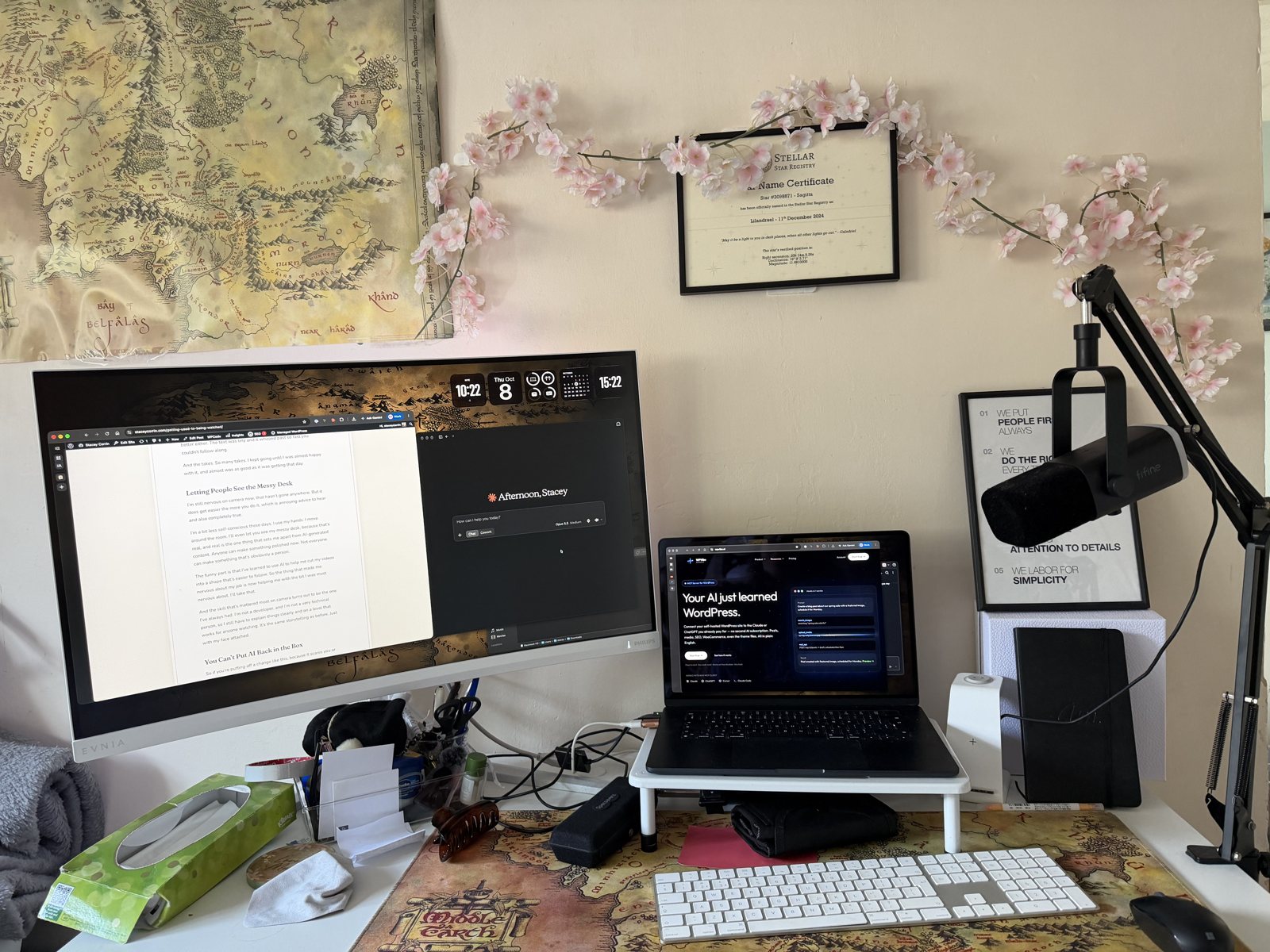
I’m a bit less self-conscious these days. I use my hands. I move around the room. I’ll even let you see my messy desk, because that’s real, and real is the one thing that sets me apart from AI-generated content. Anyone can make something polished now. Not everyone can make something that’s obviously a person.
The funny part is that I’ve learned to use AI to help me cut my videos into a shape that’s easier to follow. So the thing that made me nervous about my job is now helping me with the bit I was most nervous about. I’ll take that.
And the skill that’s mattered most on camera turns out to be the one I’ve always had. I’m not a developer, and I’m not a very technical person, so I still have to explain things clearly and on a level that works for anyone watching. It’s the same storytelling as before. Just with my face attached.
You Can’t Put AI Back in the Box
So if you’re putting off a change like this, because it scares you or because you’d honestly rather things stayed the way they were, I do get it.
Change is scary. With something like AI there’s always that fear you’re about to become obsolete, and some of those fears are fair. But it isn’t going away. You can’t put it back in the box. And I think the difference between leaning into a change and digging your heels in against it is what separates the people who move forward from the people who get left behind.
Pushing myself into video has given me a much wider set of skills than I had a year ago, and that opens doors I didn’t even know were there. Working with the change, rather than pretending it isn’t happening, has made things easier for me in the long run, not harder.
Who I Message When the Doubts Creep In
I’m in a much more confident place now than I was back in June. It takes me far less time to plan and make a video, and I believe in the work and the difference it’s making.
The doubts still come, of course. That “this isn’t good enough” feeling. Impostor syndrome creeping in the way it always does.
When it does, I fire off a quick message to my boyfriend. “What do you think?”
He’s not technical and he’s not in my field at all, which makes him the perfect guinea pig. If what I’m trying to say makes sense to him, it’ll make sense to the people I’m making it for. He might be a little bit biased. But he gives me an honest answer, and that helps more than he probably knows.
So that’s where I am. Still nervous, still learning, and slowly getting used to being watched.
And honestly? I’ve stopped minding who’s watching.
Written in Devon, October 2026.
Got thoughts on this? Send me a note →